Anatomy of a Vivaldi-Inspired Neoclassical Rock Guitar Solo
The solo originally appeared in Teutonic Knights, now heard in Does Anyone Know Rip Van Winkle?
This article presents a measure-by-measure analysis of the Vivaldi-inspired neoclassical rock guitar solo from my original composition Teutonic Knights. The piece later became Star Tower and ultimately Does Anyone Know Rip Van Winkle? .
The analysis is concerned with more than the construction of a guitar solo. It provides a concrete example of a compositional principle I explore more fully in my essay Multiplicity Within Unity: A Mark of Great Music : the derivation of pleasing musical variety from the most economical initial material suitable to a given musical goal.
The qualification “suitable to a given musical goal” is important. Economy does not mean making music as simple as possible. A musical idea must first be sufficient to capture the sound, character, or atmosphere the composer intends. An idea simpler than that is not economical; it is inadequate. Once suitable material has been found, however, a fascinating compositional question arises: what variety, pleasing to the composer, lies latent within this starting material?
The solo examined here offers a particularly clear example. Its opening measure contains only four pitches—E, F♯, G, and B—and begins within an equally restrained arrangement. Yet this small initial vocabulary becomes the source of an extended musical argument. Register changes. Notes are added and subtracted. Melodic contours expand. Rhythmic density changes. Independent instrumental lines emerge and later converge in unison. Chromatic material alters the character of the melody. Repetition creates emphasis, while silence and longer note values create contrast. The result is not merely variety, but multiplicity within unity: many musical consequences unfolding from material sufficiently definite to give the whole a recognizable identity.
There is another reason I have returned to this solo. Years after recording Teutonic Knights, I undertook to record the composition again. What began as a rerecording gradually became something much more substantial. It first developed into Star Tower, a rock song with vocals and lyrics, before changing again into the instrumental Does Anyone Know Rip Van Winkle? .
This unusual journey—from Teutonic Knights, through Star Tower, and finally to Does Anyone Know Rip Van Winkle?—has made the piece an especially useful illustration of something a written analysis can easily overlook: the powerful role of interpretation. I rewrote portions of the sheet music along the way, but a surprising amount of the underlying musical material remained intact. A score establishes pitches, rhythms, relationships, and structure, but those things do not completely determine the musical result. The same underlying material can acquire a remarkably different character through phrasing, articulation, dynamics, tone, instrumental balance, production, orchestration, and the innumerable small decisions involved in performance.
Star Tower was an important stage in that transformation. Material originally conceived as an instrumental composition became part of a song with vocals and lyrics, introducing an entirely new expressive dimension. The piece then changed again, returning to an instrumental form as Does Anyone Know Rip Van Winkle?. The present recording is not simply a newer version of Teutonic Knights, nor merely an instrumental version of Star Tower. It reflects years of subsequent musical experience and a different understanding of what the same underlying material could become.
The arrangement changed throughout that process as well. Orchestration, counterpoint, instrumental balance, and production were reconsidered around musical material that often remained recognizably related to the earlier piece. This is particularly significant in light of the principle explored throughout this article. Additional voices or changed textures are not valuable merely because they make a passage bigger or denser. They can reveal further musical possibilities within material that was already there. Counterpoint allows existing ideas to enter into new relationships; orchestration changes the perspective from which those ideas are heard.
In this sense, the journey from Teutonic Knights through Star Tower to Does Anyone Know Rip Van Winkle? extends the principle of multiplicity within unity beyond composition in the narrow sense. The principle operates within the original solo as a small motive generates larger melodic consequences; within the arrangement as independent voices emerge around the principal line; within interpretation as substantially the same written material takes on a different musical character; and even across multiple realizations of the composition, as related musical material gives rise to strikingly different musical experiences.
What follows, then, is not intended primarily as a catalogue of guitar licks or techniques. It is an examination of how a musical idea can grow while remaining itself—and, in retrospect, how a composition that seemed finished could contain possibilities I had not yet discovered.
Please note: The solo analyzed below originated in Teutonic Knights. Years later, I returned to the composition and substantially reworked it, first as the vocal rock song Star Tower and ultimately as the instrumental Does Anyone Know Rip Van Winkle?. Much of the underlying musical material, including the solo examined here, survived this long process of transformation.
Measure 1: Economy and the Opening Motive
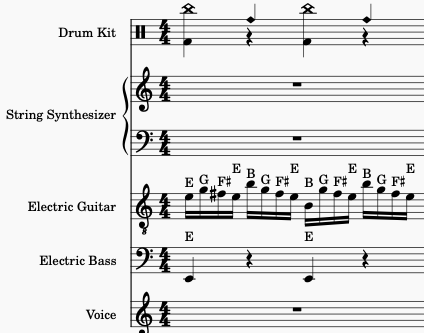
The solo begins with remarkable economy. Only four pitches—E, F♯, G, and B—appear throughout the measure, yet they form the melodic foundation of the opening phrase. By restricting the pitch material so severely, the music allows its rhythm, contour, and small internal changes to carry greater weight.
The opening gesture, E–G–F♯–E, is followed by B–G–F♯–E, which is stated three times in succession. The repeated descent gives the measure a clear motivic identity while the continuous sixteenth notes create forward motion. Rather than presenting a new lick every beat, the solo gives the listener one recognizable idea and allows it to establish itself.
Beneath the guitar, the bass articulates E on beats 1 and 3, creating a tonic pedal. The drum part supplies a broad, restrained pulse, while the string synthesizer and voice remain silent. This deliberately sparse accompaniment leaves the guitar fully exposed and prevents the opening motive from being obscured by unnecessary harmonic or textural activity.
For a guitarist-composer, one practical lesson is: a small, clearly defined melodic cell can be more memorable than a long scalar run, especially when the accompaniment gives it room to register. By limiting both the pitch material and the orchestration here, the opening makes even modest variations in the following measures sound striking.
Measure 2: Registral Variation
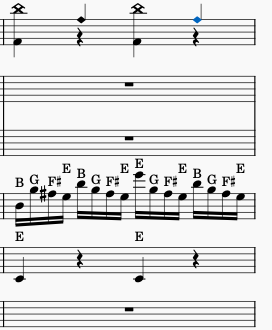
Measure 2 initially continues the recurring figure established in the opening measure. The pattern B–G–F♯–E appears twice without alteration, preserving the restricted pitch material and continuous sixteenth-note motion of the opening.
The third group introduces the first registral expansion. Its opening B is replaced by the higher E, producing E–G–F♯–E. Because the final three notes remain unchanged, the higher E is heard not as a new motive but as a variation of the established figure. The original B–G–F♯–E pattern then returns in the final group, restoring the earlier register before the measure closes.
Beneath the guitar, the bass repeats the E notes heard on beats 1 and 3 in the preceding measure. This sustained tonic foundation prevents the repeated melodic figures from implying a harmonic progression; instead, the changing upper notes are heard as activity unfolding above an E pedal point. The bass therefore gives the passage harmonic stability while the guitar supplies its internal motion.
The drum part also repeats the restrained pattern of Measure 1, articulating the principal beats without matching the guitar's constant sixteenth-note activity. The contrast between the broad rhythmic framework of the accompaniment and the rapid surface motion of the solo keeps the texture clear. The string synthesizer and voice remain silent, allowing the small registral change in the guitar to carry greater structural weight.
Measure 2 thus develops the opening material through minimal change. The accompaniment remains fixed while a single note in the guitar is displaced upward, demonstrating how variation can arise from a small alteration within an otherwise stable musical environment.
Measure 3: Development Through Subtraction
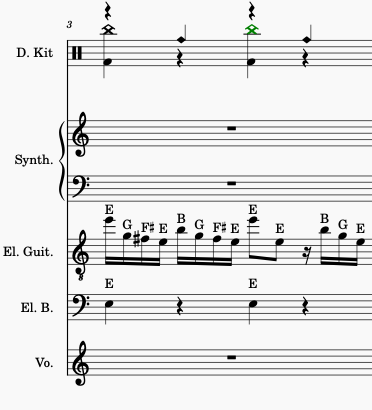
Measure 3 begins by restating the two principal melodic figures introduced earlier: E–G–F♯–E, followed by B–G–F♯–E. At first, the listener has no reason to expect anything different.
The surprise comes in the second half of the measure. Rather than maintaining the uninterrupted stream of sixteenth notes, the melody pauses. That brief silence immediately draws attention because it interrupts a rhythmic pattern that has remained constant since the beginning of the solo. Sometimes the most noticeable note is the one you choose not to play.
The closing figure, B–G–E, also removes a note from the familiar motive by omitting F♯. Nothing new is added; instead, material is taken away. This is an important compositional lesson. Development is not always achieved by increasing complexity. Just as often, a phrase becomes more expressive by simplifying it. A well-placed rest or the omission of a single note can reshape a familiar idea while preserving its identity.
Measure 4: Expansion Without Loss of Identity
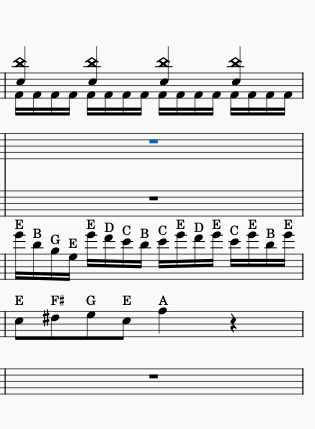
Up to this point, the solo has relied on an intentionally restricted collection of notes. Measure 4 is the first place where that vocabulary begins to expand in a noticeable way. New pitches appear, the melodic line becomes longer, and the phrase explores a wider range without abandoning the musical identity established in the opening three measures.
The measure begins with E–B–G–E, outlining E minor before introducing D and C through figures such as E–D–C–B. Although the melodic vocabulary grows, the repeated return to E keeps the phrase anchored. Expansion is successful because the listener always has a familiar point of reference.
The accompaniment also becomes more active for the first time. Instead of remaining on a static E pedal, the bass moves through E–F♯–G–E–A, creating an independent melodic line beneath the guitar. This gives the arrangement greater depth without competing with the solo, since each instrument occupies its own rhythmic role.
This measure illustrates a valuable compositional principle. Developing a musical idea does not require abandoning it. Expand gradually. Introduce one or two new notes, lengthen the phrase, or allow the accompaniment to become more active, but preserve enough familiar material that the listener always recognizes the original idea. Growth is most convincing when it feels inevitable rather than abrupt.
Measure 5: Giving Every Instrument a Role
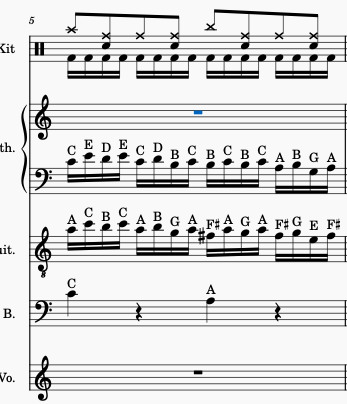
By Measure 5, the solo has expanded well beyond the restricted vocabulary of the opening. The melodic line now ranges more freely through the notes of E minor, yet it remains connected to the ideas introduced in the first four measures. Rather than abandoning the opening language, the melody develops it into longer, more varied phrases.
The most significant change, however, occurs in the arrangement. The string synthesizer no longer functions as simple background support. Instead, it introduces an independent melodic line that moves beneath the guitar. The result is a texture in which two distinct voices interact without either one merely doubling the other.
At the same time, the electric bass adopts a different responsibility altogether. Its longer notes, moving from C on beat 1 to A on beat 3, establish a stable harmonic foundation while allowing both the guitar and synthesizer to move freely above it. Each instrument therefore occupies its own musical space: the guitar carries the principal melody, the synthesizer supplies inner motion, and the bass provides structural support.
This measure illustrates an important principle of arranging. A larger sound does not necessarily come from adding more notes or more instruments. It comes from assigning each instrument a clear musical purpose. When every part contributes something different, the arrangement becomes fuller, clearer, and more expressive than if every instrument simply followed the lead guitar.
Measure 6: Developing the Established Texture
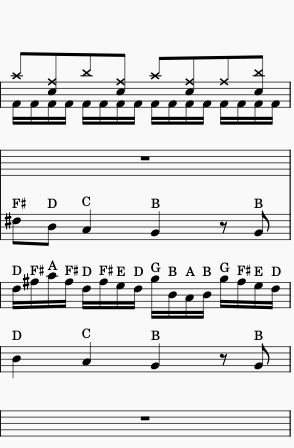
By this point, the expanded melodic language introduced in the previous measure has become the new normal. The guitar opens with D–F♯–A–F♯, continues through D–F♯–E–D, and later descends with G–B–A–B before concluding G–F♯–E–D. Although the melody now spans a wider range than the opening, it still unfolds through short, memorable phrases rather than long scalar passages, preserving the solo's identity.
The string synthesizer continues its independent melodic role beneath the guitar, while the electric bass descends from D to C and then B in longer note values. Because these accompanying voices move at a different rhythmic pace from the lead guitar, the arrangement remains spacious and clear even as the musical texture grows more active.
One subtle arranging detail is the relationship between the drums and the bass. The cymbal accents frequently coincide with changes in the bass line, reinforcing the underlying harmonic rhythm without drawing attention away from the solo. Small points of coordination like this help an arrangement feel unified even when each instrument performs a different musical role.
This measure illustrates an important principle of composition: once you establish a successful texture, resist the temptation to reinvent it every few bars. Let the arrangement become familiar so the listener's attention naturally shifts back to the melody. Consistency is often just as important as contrast in creating a convincing musical narrative.
Measure 7: Balancing Steps and Leaps
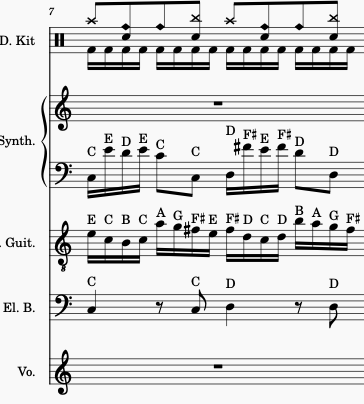
Measure 7 continues to develop the solo's melodic language without introducing an entirely new idea. The opening figure, E–C–B–C, is answered by A–G–F♯–E, before the melody rises through F♯–D–C–D and concludes with B–A–G–F♯. Although the phrase explores a wider melodic range than the opening measures, its motivic character remains immediately recognizable.
One reason the melody remains engaging is its balance between stepwise motion and wider intervallic leaps. The steps give the line a natural, singable quality, while the larger intervals provide moments of emphasis and forward momentum. Neither approach dominates the measure; each complements the other.
Beneath the solo, the synthesizer, bass, and drums continue the independent roles established in the previous measures. Because the accompanying texture has become familiar, the listener's attention naturally remains on the evolving guitar melody rather than on changes in the arrangement.
For composers, this measure offers another practical lesson: memorable melodies rarely rely exclusively on either steps or leaps. Combining both creates contrast without sacrificing coherence. A well-placed leap can add excitement, but it is often the surrounding stepwise motion that makes the phrase feel natural and easy to follow.
Measure 8: Shaping the Melodic Contour
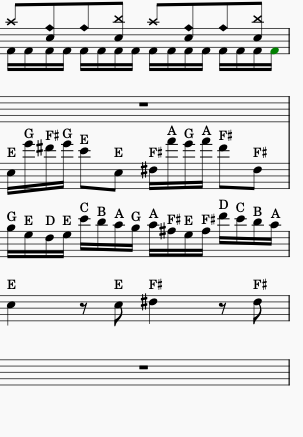
Measure 8 continues to expand the solo's melodic range while placing greater emphasis on the overall contour of the phrase. The opening figure, G–E–D–E, leads into C–B–A–G, after which the melody rises through A–F♯–E–F♯ before descending to D–C–B–A. Rather than presenting isolated motives, the measure is heard as a single, flowing musical sentence.
Notice how the phrase alternates between ascent and descent. This gives the melody a natural sense of motion, almost like the rise and fall of spoken language. Even though the individual figures remain relatively short, they combine to create a larger musical shape that carries the listener through the entire measure.
The accompanying instruments continue the independent roles established in the previous measures, providing a stable backdrop against which the guitar melody can unfold. Because the arrangement has already been established, the listener's attention remains focused on the evolving contour of the solo.
A useful compositional exercise is to stop thinking about notes one at a time and instead look at the overall direction of the melody. If you traced only its rises and falls, would it still have an interesting shape? Strong melodies are often memorable not only because of the notes they contain, but because of the way they move through musical space.
Measure 9: Register and the First High Point
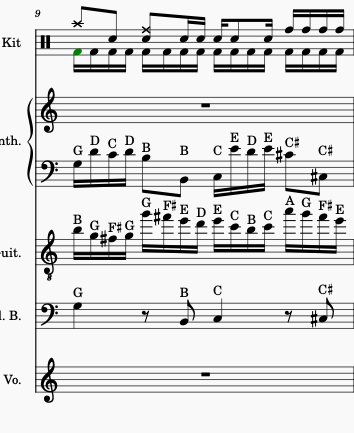
Measure 9 opens with the highest note heard thus far in the solo. Rather than remaining in the upper register, however, the melody immediately descends before climbing again. The phrase continually alternates between higher and lower registers, creating a much more dramatic contour than the comparatively restrained opening measures.
This illustrates an important principle of melodic writing: the highest note in a phrase carries tremendous expressive weight. If every measure reaches the same register, the music quickly loses its sense of direction. By delaying the melodic peak until this point in the solo, the line gains a natural feeling of arrival and increased intensity.
Beneath the guitar, the accompanying instruments continue the independent roles established earlier. Because the arrangement remains stable, the listener's attention is drawn almost entirely to the expanded register of the melody and its growing sense of momentum.
When composing your own solos, think about register as carefully as rhythm or harmony. The placement of a single high note can shape the emotional trajectory of an entire phrase. Sometimes the most effective way to create excitement is simply to wait before reaching the top of the melody.
Measure 10: A Change of Melodic Color
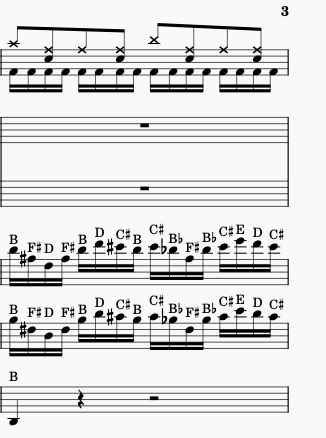
Measure 10 marks a decisive change in the character of the solo. The preceding measures drew heavily upon a melodic language reminiscent of the Baroque, but here the introduction of a broader collection of accidentals produces a noticeably harder, more aggressive sound. The rhythmic drive remains unchanged, yet the melodic color shifts unmistakably, reminding the listener that the Vivaldian influence exists within the framework of a modern metal composition rather than as a historical reconstruction.
One of the most effective ways to sustain a listener's interest is to vary the character of the music without abandoning its identity. Here, the rhythm and overall momentum remain familiar, but the altered pitch material changes the emotional atmosphere almost immediately. Composers often think of development in terms of adding notes or increasing speed, but a change in melodic color can be just as dramatic.
Measure 11: Power Through Unison
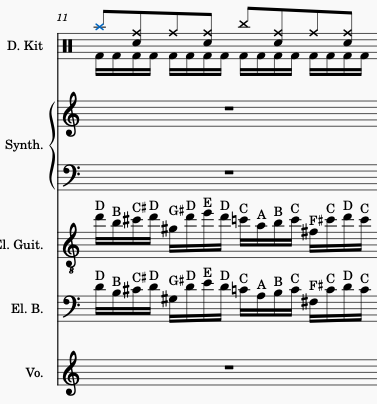
Rather than functioning as an isolated departure, the altered melodic language introduced in the previous measure continues here with even greater conviction. Chromatic pitches are now woven naturally into the line, producing a sharper melodic profile while preserving the relentless rhythmic drive established from the beginning of the solo. The result is a passage whose character is unmistakably more aggressive than the opening measures.
The most significant change, however, is textural. After several measures in which the guitar and bass pursued independent musical roles, the two instruments now move in complete unison. This immediately increases the weight and authority of the phrase. The effect comes not simply from doubling the notes, but from the contrast with the contrapuntal writing heard earlier in the solo.
This measure illustrates an important arranging principle: independence gives unison its power. If every instrument doubles the melody from the beginning, the effect soon loses its impact. By first allowing the voices to develop independently and then bringing them together at a climactic moment, the music gains a sense of strength and inevitability that would be difficult to achieve otherwise.
Measure 12: Consolidating the Heavier Passage
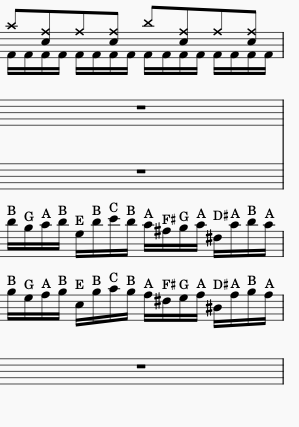
Measure 12 continues the heavier melodic language established in the preceding two measures. The electric guitar and bass remain in complete unison, reinforcing the weight and directness of the phrase while maintaining the uninterrupted rhythmic momentum. Rather than introducing new ideas, this measure consolidates the stylistic shift that began in Measure 10, allowing the more aggressive melodic vocabulary to become firmly established before the solo moves in a new direction.
Measure 13: Returning to Independence
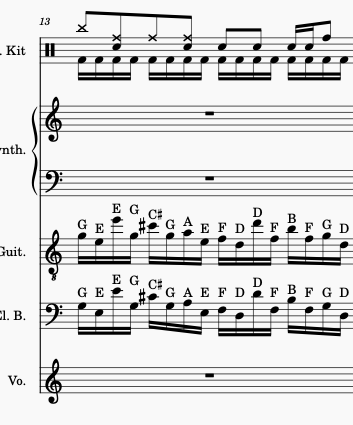
Measure 13 marks a subtle but important textural change. After two measures of complete unison between the electric guitar and bass, the bass resumes its traditional supporting role, allowing the guitar once again to stand as the principal melodic voice. Simply ending the unison restores a greater sense of openness without requiring any increase in instrumental forces.
This measure demonstrates that contrast is often created by context rather than by complexity. Nothing dramatic has to happen in the melody itself. Because the listener has grown accustomed to the powerful unison texture, the return to independent lines immediately feels lighter and more spacious. Effective arranging is often about knowing not only when to introduce an idea, but also when to let it go.
Measure 14: Variation Without Literal Repetition
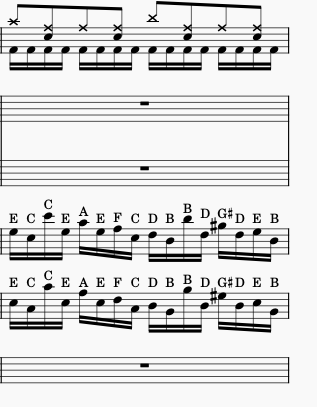
Measure 14 continues the heavier melodic language established in the preceding section while deliberately avoiding literal repetition. Although the rhythmic profile remains familiar, the melodic line is continually reshaped, allowing the solo to maintain its momentum without sounding predictable. The listener recognizes the musical language, even as the individual phrases continue to evolve.
This illustrates a useful compositional principle: repetition is most effective when it is varied. If a phrase returns unchanged too many times, the listener begins to anticipate every note. By preserving the rhythmic identity of the passage while altering the melody, the music achieves both familiarity and surprise. The solo therefore continues to feel connected to what came before while still moving convincingly forward.
Measure 15: Renewing the Intervallic Language
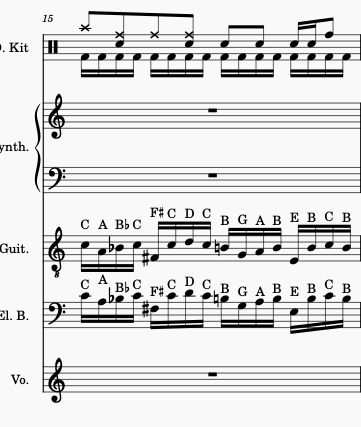
By Measure 15, the solo has already established a clear melodic identity. Rather than relying on familiar scalar movement, this phrase refreshes the musical language through a wider variety of intervallic motion. Larger skips interrupt shorter stepwise ideas, giving the melody a more animated and conversational quality without disrupting its rhythmic drive.
One of the challenges of writing a longer solo is maintaining the listener's attention without constantly introducing completely new ideas. Small changes in melodic shape can be remarkably effective. Here, the rhythm remains familiar, but the changing intervals prevent the phrase from becoming predictable. The solo continues to evolve while still sounding like the same musical voice.
Measure 16: Preparing the Next Phrase
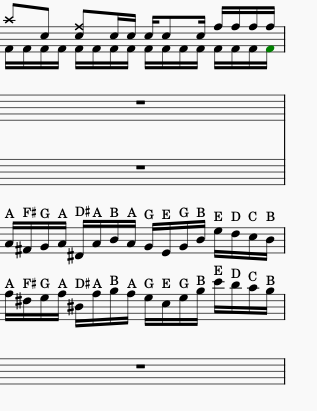
Rather than introducing a completely new idea, Measure 16 continues the melodic language established over the previous several measures. Its purpose is not to provide another climax, but to complete the current phrase while maintaining the solo's forward momentum.
The closing descent, E–D–C–B, creates a natural sense of resolution without sounding final. Instead of ending the musical conversation, it gently guides the listener toward what follows. The phrase feels complete, yet it also creates the expectation that the solo is about to continue.
This illustrates an important principle of phrasing. Not every measure needs to introduce new material or reach a dramatic peak. Some of the most effective passages simply prepare the next idea. Thinking in terms of musical sentences rather than isolated licks helps a solo unfold with a stronger sense of direction and continuity.
Measure 17: Changing the Melodic Architecture
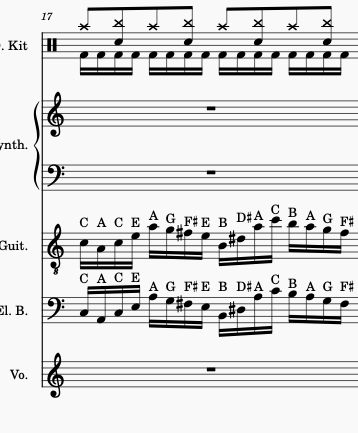
Measure 17 opens with a clearly articulated arpeggiated figure before returning to the more angular melodic language established in the preceding measures. The contrast between the broken-chord outline and the following stepwise motion gives the phrase a stronger sense of shape than a continuously linear melody would provide.
One effective way to sustain interest over a longer solo is to vary not only the notes you choose, but the way those notes are organized. Here, the opening arpeggio immediately changes the character of the line without altering the overall rhythmic drive or stylistic direction. The listener hears the same musical voice, but expressed through a different melodic design.
This illustrates a useful compositional principle: variety can come from changing the architecture of a phrase rather than its musical language. Alternating between arpeggiated figures, stepwise passages, and wider intervallic ideas helps a solo remain engaging while preserving a coherent musical identity.
Measure 18: Trusting an Established Language
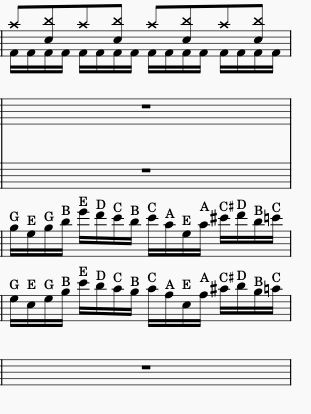
Measure 18 continues the melodic approach established in the preceding measures, allowing the solo to build through continuation rather than constant reinvention. Although the individual notes continue to evolve, the rhythmic profile and the close coordination between the guitar and bass preserve the identity of the phrase, giving the passage a strong sense of cohesion.
This illustrates an important lesson in composition: once a musical idea has earned the listener's attention, it does not need to be replaced immediately. Developing an existing language is often more satisfying than continually introducing unrelated ideas. Continuity gives the listener time to absorb the character of the music while allowing the larger structure of the solo to unfold naturally.
Measure 19: Building Emphasis Through Repetition
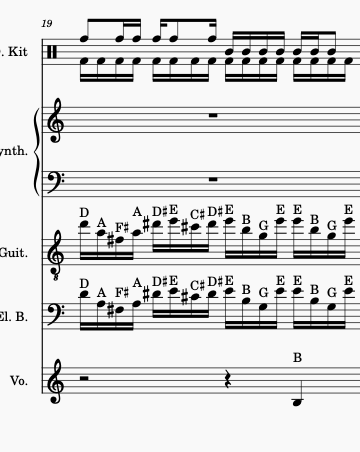
Measure 19 introduces a subtle but effective change in the melodic design. Rather than continually presenting new pitch combinations, the phrase begins to settle on repeated high E's. Instead of weakening the melody, this repetition makes the note increasingly prominent, giving the phrase a stronger sense of focus while preserving the relentless rhythmic drive established throughout the solo.
This illustrates an important principle of melodic writing. Repetition can be just as expressive as constant variation. Returning to a single target note gives the listener something familiar to grasp amid the surrounding motion, making that pitch sound increasingly significant each time it reappears. A convincing climax often comes from emphasizing the right note, not from adding more notes.
Measure 20: Creating Contrast Through Rhythmic Space
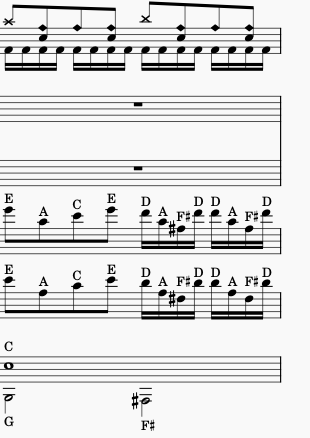
After an extended passage of continuous sixteenth-note motion, Measure 20 briefly changes the rhythmic character of the solo by introducing longer note values before gradually returning to faster movement. The effect is immediate: the melody is given room to breathe, allowing each sustained note to command more attention than it could amid uninterrupted activity.
This illustrates one of the most effective ways to create contrast in a solo. Intensity does not come solely from playing more notes or playing faster. Sometimes it comes from temporarily doing less. By relaxing the rhythmic pace for a moment, the music refreshes the listener's ear and makes the eventual return of rapid motion feel even more exciting. Often, the most effective way to increase energy is to momentarily reduce it.
Measure 21: Letting the Contrast Unfold
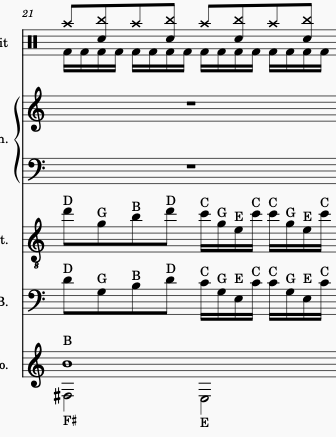
Measure 21 continues the rhythmic contrast introduced in the previous measure. Rather than immediately returning to uninterrupted sixteenth-note motion, the melody begins with longer note values before gradually accelerating during the second half of the bar. The result is a phrase that feels naturally paced rather than abruptly changing direction.
This illustrates an important principle of musical pacing. Once you've introduced a contrasting idea, give it enough time to make an impression. If the solo were to return immediately to its earlier rhythmic intensity, the contrast would lose much of its expressive power. By allowing the slower rhythm to extend into a second measure, the music creates a more convincing sense of shape and direction.
For composers and improvisers alike, this is a useful reminder that pacing unfolds across phrases, not just individual measures. Musical ideas often become more persuasive when they are allowed to develop over time rather than appearing and disappearing in a single bar.
Measure 22: Recurring Motive as Identity
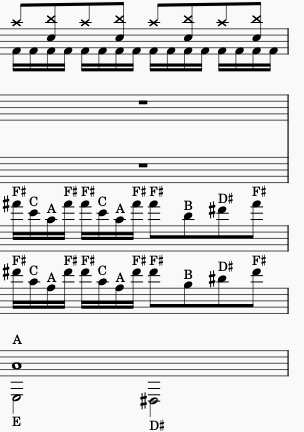
Measure 22 demonstrates that memorable solos do not require a constant stream of new ideas. The recurring F♯–F♯–C figure functions as a recognizable melodic cell whose repeated appearances give the phrase a stronger sense of identity. Rather than interrupting the musical flow, the recurrence helps unify it.
This illustrates an important compositional principle. Listeners rarely remember an isolated note or lick; they remember patterns. By allowing a short melodic idea to return, you give the ear something familiar to recognize and anticipate. Repetition is most effective when it reinforces the identity of a phrase rather than merely filling time, and this measure shows how a small motive can help bind an extended solo into a coherent musical whole.
Measure 23: Focusing the Approach to Resolution
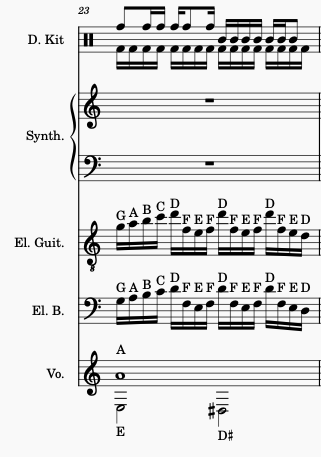
Rather than continually expanding the melodic vocabulary, Measure 23 deliberately narrows its focus. After an ascending gesture, the repeated D becomes the principal point of emphasis, concentrating the listener's attention on a single melodic target as the solo approaches its conclusion.
This illustrates an important principle of phrasing. As a musical idea approaches its resolution, it often becomes more effective to clarify the destination than to introduce additional material. The repeated D creates a growing sense of expectation, making the eventual resolution feel earned rather than abrupt.
Measure 24: A Decisive Conclusion
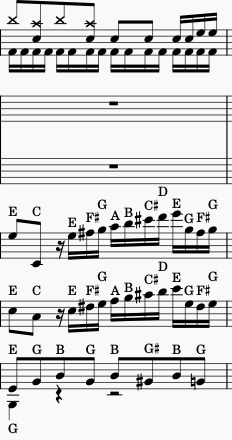
The final measure brings the solo to a conclusion without introducing unnecessary new material. After a brief ascending gesture, the melody settles naturally into its closing phrase. The ending works because the solo has already done its developmental work: the final bar does not need to prove anything new. It only needs to make the accumulated motion feel complete.
That restraint matters. A conclusion is strongest when it sounds like the inevitable consequence of what preceded it rather than one last attempt to surprise the listener. The solo began by establishing identity through economy; it ends by trusting the identity that twenty-three measures of development have already made clear.
What the Solo Reveals About Composition
Taken as a whole, the solo is less a demonstration of accumulation than of controlled transformation. Its continuity comes from allowing recognizable material to survive while other dimensions of the music change around it. Pitch content expands, register rises, rhythms contract and relax, accompanying voices move from independence to unison and back again, and recurring notes acquire different structural meanings according to their placement.
This is the practical sense in which I use the phrase multiplicity within unity . The point is not to begin with the fewest notes imaginable. The initial idea must first be sufficient for the desired musical result. The compositional achievement lies in discovering how much pleasing variety can then be drawn from that material while its identity remains perceptible.
The Vivaldian element therefore lies deeper than surface resemblance. What interests me most is the Baroque habit of generating forward motion from a clearly defined musical substance: sequence, variation, patterned motion, registral development, and the interaction of independent lines. Electric- guitar technique serves that process rather than replacing it.
The transformation of Teutonic Knights through Star Tower and finally into Does Anyone Know Rip Van Winkle? has made the same principle visible at a larger scale. Some of the notation changed, as did the arrangement, interpretation, sound, phrasing, production, orchestration, and even, for a time, the fundamental conception of the piece as instrumental music. Yet much of the underlying musical material survived. The score is therefore not the end of a composition's possibilities; it is a structured field within which further possibilities can be discovered.
For the guitarist-composer, the broader lesson is to begin with the simplest idea that is still sufficient to capture the sound one actually wants. Then remain with it long enough to discover what it contains. Variety is valuable, but it becomes far more powerful when the listener can still hear the unity beneath it. The long journey from Teutonic Knights to Does Anyone Know Rip Van Winkle? has convinced me that this principle can operate not only within a composition, but across the life of the composition itself.
The earlier transformation of the piece is documented in The Guitarist-Composer .